
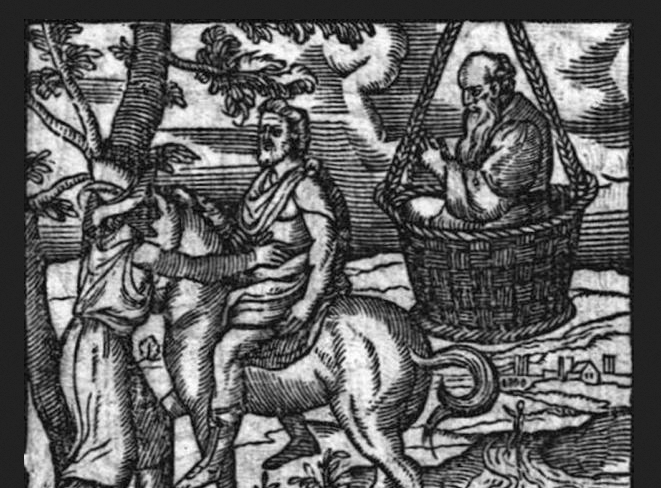
Why is Socrates swinging in a basket? Because it’s good for him and the world in general. Tom Hodgkinson explains
In the middle of tragedy, we need comedy. The comedy of 5th century BC Athens came to be known as the Old Comedy. It was about topical satire (the later New Comedy avoided identifying real people).
Old Comedy’s best known practitioner was Aristophanes, who, as some of you will know, has a walk-on part in Plato’s Symposium. Here he spins an elaborate tale to explain why love exists. In past times, he says, the world was inhabited by a race of hermaphroditic roly-poly creatures with four arms, four legs and two heads.
These creatures zoomed around the world at great speed. The gods in the heavens became worried by their power and decided to cut them down to size. Zeus, Aristophanes says, took the creatures and cut them in half with a wire, in the same way as you would slice a hard-boiled egg in two.
These incomplete half-humans – now with only two legs, two arms and one head each – then roamed the planet looking for their other half. Hence love.
Aristophanes’ plays were equally silly and fantastical. They were knockabout, almost pantomimic, and satirised well-known Athenians of the day.
In The Clouds, an old man with debts sends his son to a philosophical school called the Phrontisterion, or “Thinkery”. This is a school run by Socrates, or a caricature of him. The idea is that the son will become so well trained in the art of ingenious argument that he will be able to argue his way out of the debts.
Socrates is presented as a cast-iron loon, a bearded cult leader, who towers above ordinary people in a basket which is suspended above the stage, the idea being, clearly, that his head is in the clouds. In the play (certainly not in real life) he also charges astronomical fees.
The play was performed at the Dionysia festival in Athens in 423 BC and Socrates (a pal of Aristophanes) was in the audience. The story goes that non-Athenians present were asking each other, “Who is this Socrates?” Whereupon Socrates stood up both to identify himself, and also to show that he was indifferent to the quite savage teasing of The Clouds.
A second play performed at the same festival also savaged Socrates. In the Connus by Ameipsias, we read the following dialogue, which teased the philosopher for his simple garb and habit of going shoeless:
A: Socrates – shining in a small gathering, eclipsed in a large – have you come to join us as well? Tough, eh? Where did you get that coat? No shoes on your feet. You’re bankrupting the cobblers with your insults!
B: Still he’d rather starve than flatter!
Another comic poet, Eupolis, wrote:
Yes and I loathe that poverty-stricken windbag Socrates who contemplates everything in the world but does not know where his next meal is coming from.
Socrates remained Stoical in the face of these insults (though the word Stoical had not yet been invented), reportedly saying: “We ought not to object… to be subjects for the Comic poets, for if they satirise our faults they will do us good, and if not they do not touch us.”
In other words, he’s saying that the piss-taking dramatists might have a point, and if they don’t have a point, then who cares?
So the Old Comedy is a bit like Spitting Image, which also parodied the politicians and celebs of the day, and Not the Nine O’Clock News, both produced by the avuncular John Lloyd.
All of which brings me to “A Drink with the Idler”, on which our guest this week (Thursday 19) was Old (and New) Comedy practitioner par excellence, Griff Rhys Jones. And what an engaging, funny and thought-provoking evening it was.
Click on these links to find out more about our upcoming “Drinks”: Georgia Mann, Louise Winter, Emma Southon, Rupert Sheldrake and Anna Keay. Free for subscribers.
Subscribers can watch John Lloyd on “A Drink with the Idler” here. Or check out last week’s “Drink” with Cory Doctorow on how to smash Big Tech here.
PS You’re invited to a party in London on Wednesday 6 December to celebrate thirty years of the Idler. Entry is free when you pre-order a copy of our new limited-edition publication, XXX: Thirty Years of the Idler. Click here to reserve your place. To pre-order the book but not come to the party, click here.

Our September/October issue is available is available in Waitrose, Waterstones, Smiths Travel outlets, select Smiths high street branches and in around 100 indie stores. Click here for your nearest stockist.


You must be logged in to comment on this article.
For unlimited site access, join us as a member here or login