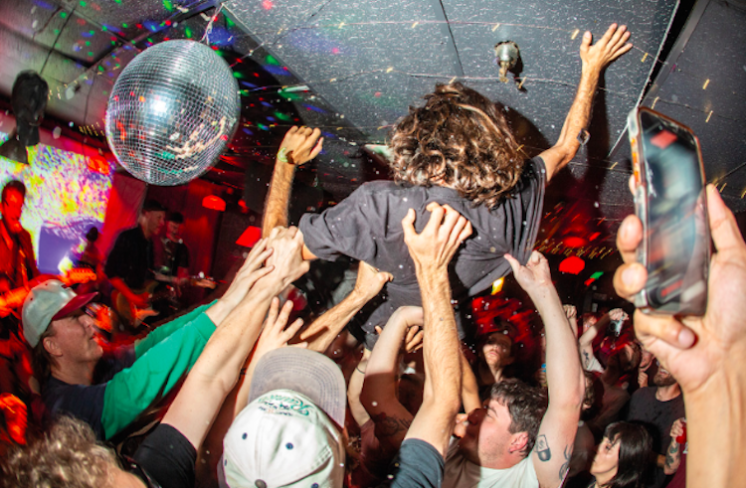
Journalist, photographer and skateboarder Josh Sabini crowd surfs. Photo by Allen Phillips
With skateboarding becoming increasingly corporatised, skater Thom Callan-Riley reports on an event that’s helping it reclaim its soul
Back in February I travelled to Tempe, a suburb of Phoenix, Arizona, to join 200 or so other attendees for the fourth edition of Slow Impact, a Thursday-to-Sunday skateboarding event that’s part academic conference, part skate session, and part community meeting. Like skateboarding itself, this cultural gathering embraces being multiple things at once. It is everything and nothing. Meaningless and meaningful.
Skateboarding has become decidedly mainstream in recent years, with versions of it now part of institutions like the Olympics. Many organisations are launching “professional skateboarding leagues” this year, sponsored by cryptocurrency platforms or venture capitalists. They’re trying to make skateboarding into a more conventional sport, to reach a wider audience, and with more potential for betting and other ways to generate money.
These institutions and outside forces are strong, and could influence what skateboarding becomes in the future. Slow Impact is a counterweight against this. It’s part of a trend of skateboarders seeking to influence what skateboarding can be – not through dramatic feats in the air or down handrails, but through talking. These gatherings are a form of worldbuilding. Sociologist Paul O’Connor describes them as “prefigurative” – we’re making skateboarding into what we want it to be. Author Kyle Beachy writes that, “whatever skateboarding is or might become depends on the way we speak [about] it.”
Making History Skateboarding has been spoken about since it began, but those with the loudest voices have always controlled the narrative. They’ve told the stories they wanted to tell and created a folklore, perpetuating a particular view of skateboarding; one of mostly older, mostly white men centred in Southern California. The narrative has been of heroes performing spectacular tricks at important sites, using the visual currency a photograph or film footage of someone doing something no one else has done before. Knowing the history of skateboarding has been portrayed as important for “authentic” skateboarders.
But in the last ten years or so there’s been a shift with regard to who has the power to shape the discourse. This has coincided with a flurry of skate gatherings like Slow Impact around the world. They challenge the dominance of the skate industry and legacy media in determining what skateboarding can and should be. They more closely follow the form of skateboarding itself: people of all different skills and experiences skateboarding together. When someone lands a trick that’s new for them, everyone cheers. A professional skater will give a “yewwww” to someone dropping in for the first time.
This isn’t a rejection of the “heroes” of skateboarding history. It’s more of a rebalancing. These gatherings draw in big names, but everyone’s contribution has value.
Wax Resistant? Skateboarders understand the simplicity, and at times silliness, of the thing we dedicate a large chunk of our lives to. On the first night of Slow Impact, I witnessed the Great Skate Debate at a local dive bar. A raucous crowd cheered as opposing teams made their case on questions such as, “Should you use wax to make something easier to skate?” and “Are dogs welcome at the skate spot?”
The next day, Friday, saw the morning session open with a stark reminder of the global political situation at the heart of the event, as Professor Alan Gomez of Arizona State University implored us to not let the fascists win by taking our joy.
Later, revelling in the sheer inexpressible joy of skateboarding, philosopher Brian Glenney opened the Paper Sessions – the closest thing in the gathering to a traditional academic conference – by arguing that skate spots are magic. Like the matsutake mushroom, they cannot be deliberately made, and rely on a unique symbiosis with their surroundings that only the wild can provide.
Getting Personal There were presentations from community activists, educators, professional skateboarders, archivists and architects, to name a few. We heard powerful individual stories and practical ways to make skateboarding, and the world, a better place.
Lee took up skateboarding at the same time as coming out as a trans person. How they thought about their body influenced how they thought about space. Skateboarding can benefit, said Lee, from designing non-binary spaces; spaces that don’t fit into existing classifications. Not having a clear definition of space requires you to negotiate – to engage with other users.
Mother and son Suzy and Kyle, from the Oglala Lakota Nation, told us how they had built a skatepark and community space on the Pine Ridge Reservation, an outlet away from issues of drug and alcohol addiction. “If I can do it, anybody can,” said Kyle.
Above all, this was an affirmation of community. Instilling the power in people to take the experience back to their own towns and cities. For the impact to resonate, slowly. Like skateboarding itself, Slow Impact is a feeling that stays with you. It isn’t a meeting to settle what skateboarding is, but to show what skateboarding can be.
That evening, a large group of us went on a sunset hike through the Mars-like landscape on the edge of town. It proved to be one of my favourite elements of the event. An act of community, a sense of adventure, no hierarchy. It achieved that thing you get when you speak to people without looking at them, like on a long car journey. The opposite of a networking event where you have to maintain an acceptable level of eye contact. Then we enjoyed a busy skate session that night.
Anything Goes After a day of panel discussions, street sessions, and social gatherings, author Kyle Beachy hosted his “Anything at All” reading session in the evening, a programme of performances, stories, essays, and other creative works, bridging the gap between skateboarding culture and literary art. The pure, unbridled encouragement of the crowd, and the great setting – a skateshop, with beers on sale from a cooler – created an even more intimate and open forum than the daytime sessions. It’s one of the highlights of the weekend. We all sat rapt on the floor, or on skateboards. I can see why people come back year after year.
Sunday night saw a euphoric close to the event, with a cover band playing songs taken exclusively from skate videos. Their final song, “Under Pressure” by Queen and David Bowie, had soundtracked Heath Kirchart and Jeremy Klein’s section from the 1998 video The End. This was the first skate video I bought (on VHS of course), just after I started skateboarding in leafy Hertfordshire. I must have watched it hundreds of times. Hearing this song feels like skateboarding. In Tempe, Arizona, I was connected to skateboarders from around the world through this shared sonic history and shared feeling as each track, spanning nearly 30 years of skate videos, resonated in its own way with everyone in the crowd.
No More Heroes I’ve been trying to look at my phone less and read more. Throughout the weekend, I kept a passport-sized book by Ursula Le Guin in my back pocket: The Carrier Bag Theory of Fiction. Le Guin, a master of worldbuilding, challenges the traditional “hero’s journey” narrative of storytelling. In prehistoric times, she points out, the “mammoth hunters spectacularly occupy the cave wall and the mind, but what we actually did to stay alive and fat was to gather seeds, roots, sprouts, shoots, leaves, nuts, berries…”
Le Guin doesn’t want to tell the hero’s story. The most important tool was never a spear, she explains, it was something to gather with. A receptacle, a carrier bag. That’s what kept us alive.
The skate industry has historically capitalised on hero-worship. Individuals performing spectacular feats got their pictures in magazines. Stories of who did what and where, were passed down as folk tales. The new competition formats mentioned above are trying to make still more heroes – gold medallists, super crown champions – but we don’t need them.
Le Guin gives us a powerful lesson: we mustn’t put the meaning of what we do into the stories of heroes. We must share the stories and ideas of those who gather. The stories we tell can shape the world we live in. Through gatherings like Slow Impact, it appears we are embracing a Carrier Bag Theory of Skateboarding.
This article is from Idler #111.
Subscribers may comment. Please add your idle thoughts using the box below
Subscribe to the Idlerhere and get 17% off the shop price plus a FREE copy of Idle Thoughts by Tom Hodgkinson, worth £8.95
“A Drink with the Idler” returns in the autumn
How to Live Like a Stoic
Tom Hodgkinson’s latest book How to Live Like a Stoic: A Handbook for Happiness (Bloomsbury Continuum, £16.99) is out now. Order a copy via Linktree here.
Idler #111 (Aug-Sept 2026) is available in Waitrose, Smiths and TG Jones.
Retreat to Florence and Chianti with the Idler and discover some of Italy’s most important landscape gardens hidden in this magical city and the countryside of Chianti around it.
In an eco manor house nestled in ancient woodland learn about the Cathars, the love and song of the Troubadours, and local cuisine with special guest Rowley Leigh
Join the Idler for a retreat to little travelled Middle Egypt as we explore the ancient Egyptian hermetic philosophy that has influenced Western thinkers from the Renaissance to today.
The Idler’s Digital Academy membership gives unlimited access to 80+ online courses, plus Idler magazine in digital form, website access, back issue archive, audio and video channels.