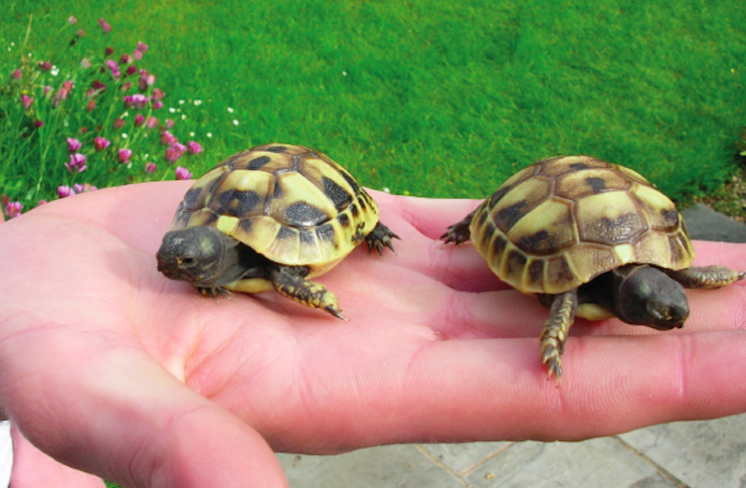
Arthur and Martha: It isn’t easy to tell your hatchlings apart until they reach maturity
Tortoise fan Andrew Quayle gets us up to speed with one of nature’s finest idlers
It was 1970 and I was 10 years old. Having saved up for months, I bought a tortoise for 10 shillings from a pet shop in the centre of Manchester. I named it Jasper. It was a scaly cobblestone that ambled round the garden and didn’t survive into 1971.
Sadly this was all too typical in those days, because tortoises were shipped, usually from north Africa, in brutal conditions. I recall seeing them being carried off a truck into the pet shop, and stacked up in wicker baskets like rocks rather than living creatures, the unlucky ones at the bottom suffocating in the waste of those above them.
Back then tortoises were still abundant all round the Mediterranean, and obviously easy to catch, so tens of thousands would be exported to northern Europe every year with little hope of survival. It was a sort of cut-flower trade in a slow-growing, slow-breeding species that really couldn’t hope to sustain such a brutal harvest without the populations crashing. Which they did, and one by one the countries around the Med started restricting, and later banning, this dreadful trade.
I had a number of tortoises after Jasper, more or less all of which went the same way. They’d been ill-treated by the pet trade, and I, basically clueless about their living needs, finished them off. When I was 18 and obsessed with reptiles, I bought a copy of A Field Guide To The Reptiles And Amphibians Of Britain And Europe (Ovanden, Arnold and Burton, 1978). The book is in front of me now, dog-eared and battered, and we’ve been round Europe together having some great nerdy times. The field guide warns about the drudgery of keeping such animals in captivity, and there’s a powerful quote specifically about tortoises: “The average semi-moribund captive tortoise bears no comparison with the alert, vigorous, herb-scented beasts that plough through the undergrowth of southern Europe.”
This latter creature, I realised, was what I should be aiming for, and it would require some good tortoise husbandry. But there was more. I’d assumed, using ancient literature sources, that there was just one Mediterranean tortoise, Testudo graeca, or Greek tortoise. But no, from eastern Spain to Bulgaria there was Hermann’s tortoise, Testudo hermanni; while in southern Greece there was the larger black, marginated tortoise, Testudo marginata, with an elongated and flared shell (reputedly used as a helmet in classical times). The “original” Greek tortoise claimed a domain from eastern Greece to Turkey and round the shores of the Mediterranean to Morocco. Over this huge range they show such variation that tortoise taxonomists (yes, is it a job) argue that the Greek tortoise actually consists of several cryptic species. Reading this, I realised that a Moroccan tortoise would obviously struggle in the Mancunian climate, whereas a Bulgarian one would be used to cold winters and might do much better.
The result was a compromise: I managed to acquire a small group of the much hardier Hermann’s tortoise, and I moved to the south of England so as to be closer to Bulgaria. And lo! In 1990 we hatched our first captive bred tortoise, and my life was complete. Their numbers grew steadily from their own breeding, but once you become known as a tortoise person, people wish them on you like unwanted family heirlooms, wrinkled retainers for whom they still feel a lingering responsibility. I was given a large female Hermann’s tortoise by my wife’s grandfather, who found it roaming in his garden. None of his neighbours claimed it and so he passed it on to me. It has since produced numerous offspring, and though obviously a female, we still call it Joe Gregory in his memory. (Although to me, giving a tortoise a name suggests personhood, which I struggle to accept.) Another large tortoise, named Shelley by my youngest son, came my way from a dentist friend who had it handed to him in his surgery. Probably our oldest tortoise, retrieved from a pet shop cellar in 1982, is still breeding and is simply known as Original. They do become family heirlooms, if not suitable for the mantelpiece.
Hermann’s tortoises are hardy and can adapt very well to the British climate, given a bit of help. They are a very low-maintenance garden companion, if you let them be. Just bear in mind that a tortoise is a reptile, and you are a warm-blooded, hairy mammal. Although its needs are simple, they’re markedly different from those of a rabbit, hamster, or indeed you.
A tortoise needs sunshine, mainly to warm up. They’ll prop themselves up against sunny garden walls to maximise their solar gain. Gilbert White, writing of his tortoise Timothy in The Natural History Of Selborne, comments on this habit: “And yet this poor reptile has never read that planes inclining to the horizon receive more heat from the sun than any other elevation.”
What the tortoise aims for is a body temperature of up to 34oC, and once this is reached it will retreat into the shade to cool down a bit, then go back into the sun. The technical term for this is shuttling heliothermy, but it means that given access to sun and shade, a tortoise will manage its own body temperature very efficiently, as long as it has a suitable sunny spot with some shade. I provide mine with an open-sided garden frame with a glass roof, where they can get out of the weather, but which also heats up rapidly in the sunshine, and the tortoises shuttle in and out of it as they wish. Unless you want to make your whole garden escape proof, and sacrifice your favourite plants, it’s best to confine garden tortoises to a few square metres of sunny ground with planking or blockwork low walls. About 4m x 2m will be fine for one or two, but bigger is better. Kept on a flat lawn they’ll be bored and possibly get shell-rot from the damp grass, so give them a variety of terrains: grass tussocks; shrubs for shade; dry stony ground or some paving sloping to the south for warmth; “diggable” soil; and a shallow water tray for drinking.
Food-wise, assume that a Hermann’s tortoise is vegan and you won’t go far wrong. Yes, they will eat a passing worm or slug if the mood takes them, but let them sort that out for themselves. Provide them with various green leaves. Dandelion, clover, plantain, sow thistle, bindweed, cabbage, kale, sprouts, and occasionally fine grasses are all suitable. These are high in fibre and vitamins, and low in fats and protein, which is ideal for a tortoise. It’s easy to feed a tortoise from bits and pieces of weeds from the average back garden, or collected in a park. Its fresh and its free. Get a plant book and become a bit of a botanist. While doing that, become a bit of a geologist as well, and leave a lump of chalk, limestone or cuttlefish bone next to the leaves, for the tortoise to chew on. All that shell needs a lot of calcium.
Never give a Hermann’s tortoise dog food, cat food, or any meat, cooked or otherwise, or jam sandwiches. Tortoises will eat all of these but the result can be colic, deformed shell growth, metabolic bone disease, kidney failure, and early death. Tortoises live about as long as humans, but only if they get a healthy diet.
What about fruit? Well, OK but only as an occasional treat. After all, how often does a wild Hermann’s tortoise find a banana in the forests of Bulgaria? Never. So a few in-season blackberries are fine, or the occasional slice of apple, tomato, or windfall apple you don’t fancy yourself (leaving the skin on). But these should be in a small quantity, probably no more than once a week. If I’m in a generous mood, I’ll eat a banana and throw the skin to the tortoises (after removing the Fyffes label). The peel is sweet but very fibrous and they love it.
What about lettuce? Shop-bought lettuce is very poor in fibre and vitamins but tortoises can get addicted to it and stop eating “proper” tortoise food. Best avoided.
Pet shops sell specially prepared food pellets for vegetarian tortoises. According to the manufacturers these are high in fibre and vitamins and are made from plant sources. On paper they look fine and I’m sure the content of them is well researched, but compared to the effort of spending 10 minutes picking a few dandelion leaves, they’re amazingly expensive. (The tortoise equivalent of bottled water perhaps). I’ve offered them to my tortoises and they were completely ignored. Probably if I withdrew their usual diet of organic weeds, they would eat the pellets when really hungry, but they look like prison rations to me.
How about hibernation? One of the great things about a garden tortoise is how they mark the seasons. They pop up in the spring with the daffodils, hit their activity peak in midsummer, and disappear under the falling leaves of autumn – provided you let them get on with it. Make sure they have access to sun and shade and diggable soil to hibernate, and trust them to know what to do. The first time I let my tortoises hibernate au naturel, they dug themselves in right on schedule in the autumn, but I then spent a nail-biting winter expecting they’d died with the first autumn frost – until they popped up next spring looking amazingly healthy. I was inevitably thinking like a mammal who only survives winter with the central heating on. The Blue Peter system of a tea chest of straw in the loft is mammal thinking. Hermann’s tortoises have been hibernating for millions of years – they know what to do. Putting them in a tea chest stops them doing it. Trust them.
I find that the only time they need extra heat is when incubating their eggs. Tortoise eggs need an average of about 26-30oC, hatching in roughly two months. But there’s a twist here, in that the sex of a tortoise is controlled by the incubation temperature. At a constant 27oC, all hatchlings will be male, while at a constant 33oC, all will be female. Taking a long view, the smart solution would be to find the ideal where about 70 per cent of the hatchlings are female, as 1:1 sex ratios get a bit bothersome, with every female being trailed by a hopeful male. I’m experimenting with incubators at 28oC most of the time but with a daily peak at 32oC. Given that all hatchling tortoises look like females until maturity, I expect a definitive result in 2035, so watch this space.
Incidentally, tortoises are only slow moving when it suits them. In the breeding season the males will actually run after their mates. At times the squeaking and clattering sounds of mating tortoises at the end of my garden are audible from the kitchen.
Finally, there’s the issue of mental health – my mental health, not the tortoises’. They really aren’t much trouble to keep, given reptile rules. But why bother with such a plodding dullard? Well, because I find them very calming after a stressful day. They demand very little of you (though they will hang around your feet begging for banana skins). A tortoise is never euphoric. Or miserable. It is stoically content, having honed its life to the longest possible stretch of wholesome idling. It will exert itself, but only for the essential needs, not glittery magpie “wants” sold as needs. They’re much too dim to have a philosophy, but if they had, I’m sure it would be that, good or bad, “This too will pass.” That could be a steadying influence in these troubled times. Their solid, unfashionable appearance speaks of endurance over the years, marked by the slings and arrows of outrageous fortune, but never felled by them. And they will stoically, calmly, unobtrusively, sit in the sun with you, for 60 or 70 summers.
Get a tortoise. And calm down.
Further Information The Hermann’s tortoise is listed on Appendix II of the Convention of International Trade in Endangered Species (CITES). When you buy a genuine, legal, captive-bred Hermann’s tortoise you should also receive a unique serial number from the CITES Article 10 sale exemption certificate. Anything without this serial number is likely to be dodgy.
I find that internet advice on keeping tortoises is often driven by the aim of selling you lots of expensive tortoise accessories of questionable value. Mine are housed with reclaimed planks and one old window frame, though I admit to a state-of-the-art electronic thermostat for the egg “incubator”, a polystyrene broccoli box from the back of a greengrocer’s shop.
For reliable tortoise advice, try the Tortoise Trust website (tortoisetrust.org). It’s evidence-based and excellent in all respects. I refer to it frequently.
This article is from Idler #79.
Subscribers may comment. Please add your idle thoughts using the box below
Subscribe to the Idlerhere and get 17% off the shop price plus a FREE copy of Idle Thoughts by Tom Hodgkinson, worth £8.95
“A Drink with the Idler” returns in the autumn
How to Live Like a Stoic
Tom Hodgkinson’s latest book How to Live Like a Stoic: A Handbook for Happiness (Bloomsbury Continuum, £16.99) is out now. Order a copy via Linktree here.
Idler #111 (Aug-Sept 2026) is available in Waitrose, Smiths and TG Jones.
Retreat to Florence and Chianti with the Idler and discover some of Italy’s most important landscape gardens hidden in this magical city and the countryside of Chianti around it.
In an eco manor house nestled in ancient woodland learn about the Cathars, the love and song of the Troubadours, and local cuisine with special guest Rowley Leigh
Join the Idler for a retreat to little travelled Middle Egypt as we explore the ancient Egyptian hermetic philosophy that has influenced Western thinkers from the Renaissance to today.
The Idler’s Digital Academy membership gives unlimited access to 80+ online courses, plus Idler magazine in digital form, website access, back issue archive, audio and video channels.