
Idler contributor Alex Johnson introduces an extract from his new book Shelf Life, a lovely anthology of essays on reading, collecting and storing books. We think it’d make a perfect Christmas present for book lovers.
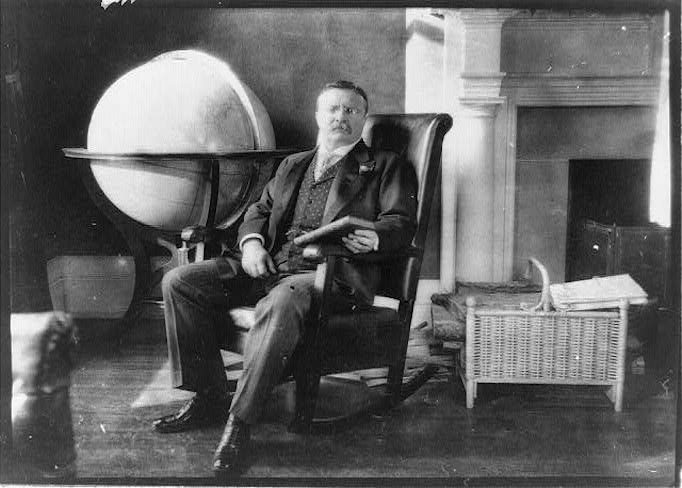
Explorer, writer, naturalist and 26th President of the United States, Theodore Roosevelt (1858-1919) is also arguably the country’s best read President. A poster boy for the speed reading movement, he whizzed through a book a day, often written in various different languages. Although Roosevelt disliked the idea of ‘must read’ book lists, believing one size did not fit all – “The room for choice is so limitless it seems absurd to try to make catalogues which shall be supposed to appeal to all the best thinkers” – he was a keen supporter of short stories and poetry.
A childhood asthmatic, Roosevelt became a great believer in the benefits of the great outdoors and the importance of physical exercise – he once described himself to be “as strong as a bull moose” and the moniker stuck, both to him and the shortlived political Progressive Party he formed. As well as a prolific letter writer, Roosevelt also wrote books on naval history, Oliver Cromwell, and the ‘Summer Birds of the Adirondacks’. The piece below comes from his book A Book Lover’s Holidays in the Open (1916). Other robust chapters include ‘A cougar hunt on the rim of the Grand Canyon’ and ‘Primitive Man and the horse, the lion and the elephant’.
I am sometimes asked what books I advise men or women to take on holidays in the open. With the reservation of long trips, where bulk is of prime consequence, I can only answer: The same books one would read at home. Such an answer generally invites the further question as to what books I read when at home. To this question I am afraid my answer cannot be so instructive as it ought to be, for I have never followed any plan in reading which would apply to all persons under all circumstances; and indeed it seems to me that no plan can be laid down that will be generally applicable. If a man is not fond of books, to him reading of any kind will be drudgery. I most sincerely commiserate such a person, but I do not know how to help him. If a man or a woman is fond of books he or she will naturally seek the books that the mind and soul demand. Suggestions of a possibly helpful character can be made by outsiders, but only suggestions; and they will probably be helpful about in proportion to the outsider’s knowledge of the mind and soul of the person to be helped.
Of course, if any one finds that he never reads serious literature, if all his reading is frothy and trashy, he would do well to try to train himself to like books that the general agreement of cultivated and sound-thinking persons has placed among the classics. It is as discreditable to the mind to be unfit for sustained mental effort as it is to the body of a young man to be unfit for sustained physical effort. Let man or woman, young man or girl, read some good author, say Gibbon or Macaulay, until sustained mental effort brings power to enjoy the books worth enjoying. When this has been achieved the man can soon trust himself to pick out for himself the particular good books which appeal to him.
The equation of personal taste is as powerful in reading as in eating; and within certain broad limits the matter is merely one of individual preference, having nothing to do with the quality either of the book or of the reader’s mind. I like apples, pears, oranges, pineapples, and peaches. I dislike bananas, alligator-pears, and prunes. The first fact is certainly not to my credit, although it is to my advantage; and the second at least does not show moral turpitude. At times in the tropics I have been exceedingly sorry I could not learn to like bananas, and on round-ups, in the cow country in the old days, it was even more unfortunate not to like prunes; but I simply could not make myself like either, and that was all there was to it.
In the same way I read over and over again “Guy Mannering,” “The Antiquary,” “Pendennis,” “Vanity Fair,” “Our Mutual Friend,” and the “Pickwick Papers”; whereas I make heavy weather of most parts of the “Fortunes of Nigel,” “Esmond,” and the “Old Curiosity Shop”—to mention only books I have tried to read during the last month. I have no question that the latter three books are as good as the first six; doubtless for some people they are better; but I do not like them, any more than I like prunes or bananas.
In the same way I read and reread “Macbeth” and “Othello”; but not “King Lear” nor “Hamlet.” I know perfectly well that the latter are as wonderful as the former—I wouldn’t venture to admit my shortcomings regarding them if I couldn’t proudly express my appreciation of the other two! But at my age I might as well own up, at least to myself, to my limitations, and read the books I thoroughly enjoy.
But this does not mean permitting oneself to like what is vicious or even simply worthless. If any man finds that he cares to read “Bel Ami,” he will do well to keep a watch on the reflex centres of his moral nature, and to brace himself with a course of Eugene Brieux or Henry Bordeaux. If he does not care for “Anna Karenina,” “War and Peace,” “Sebastopol,” and “The Cossacks” he misses much; but if he cares for the “Kreutzer Sonata” he had better make up his mind that for pathological reasons he will be wise thereafter to avoid Tolstoy entirely. Tolstoy is an interesting and stimulating writer, but an exceedingly unsafe moral adviser.
This is an extract from Shelf Life: Writers on Books and Reading (British Library, £10). Buy a copy here.

You must be logged in to comment on this article.
For unlimited site access, join us as a member here or login