
What we’re living through looks a little like the hellish world described in E.M. Forster’s short story The Machine Stops. This disarmingly prescient tale opens with a description of a pale-faced woman called Vashti sitting alone in an armchair in a sort of cell.
She gets a call from an iPad like device and asks who is calling. The narrator has clearly foreseen Facebook because he says:
She knew several thousand people; in certain directions, human intercourse had advanced enormously.
The caller turns out to be her son, Kuno. Vashti says:
“Very well. Let us talk. I will isolate myself. I do not expect anything important will happen for the next five minutes – for I can give you fully five minutes, Kuno. Then I must deliver my lecture on ‘Music during the Australian Period’.”
It was fully fifteen seconds before the round plate that she held in her hands began to glow. A faint blue light shot across it, darkening to purple, and presently she could see the image of her son, who lived on the other side of the earth, and he could see her.
This is all the more remarkable when you remember that the book was written in 1909.
Her son Kuno says:
“I want you to come and see me.”
Vashti watched his face in the blue plate.
“But I can see you!” she exclaimed. “What more do you want?”
“I want to see you not through the Machine,” said Kuno. “I want to speak to you not through the wearisome Machine.”
“Oh hush!” said his mother, vaguely shocked. “You mustn’t say anything against the Machine.”
Well, the wearisome Machine has not conquered us yet. Cycling around my local neighbourhood over the last few days, it’s been nice to see people sitting on their front steps or chatting with a neighbour who leans out of their first floor flat. Children are playing in the streets. Life has slowed down. We are reflecting on what’s important.
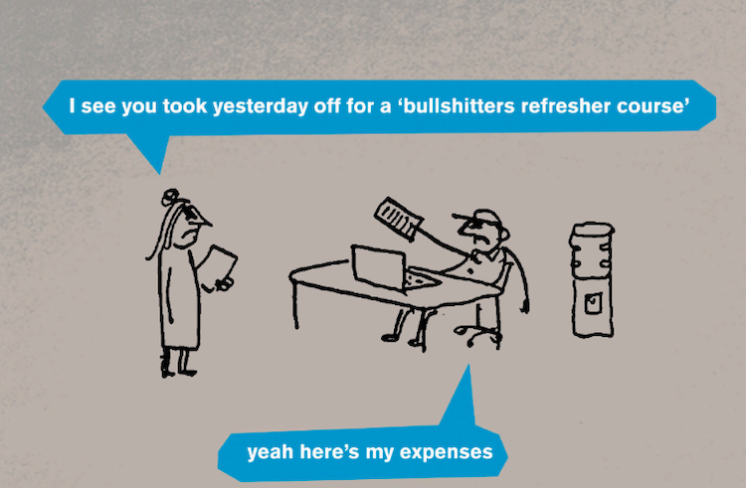
I can see two vastly different futures post-corona. One is bright. It is possible that many people, having tasted the idling life, and a bit of autonomy, will decide that they don’t want to return to their “bullshit job” and will find other ways to live. They’ll explore part-time work. They’ll minimize the things they don’t want to do (let’s call that “work”) and maximise the things they do want to do (let’s call that “idling”). And the status and wages of the key workers will increase significantly.
The other is the dystopia that many fear, whereby the already massive corporations like Microsoft, Facebook, Apple, Google, Amazon, Big Pharma and so on grab even more global power and money and put even more small businesses out of action. The sturdy yeomanry will disappear, and we’ll be faced with a choice between poverty and working for the man. Governments will hang on to the new powers they’ve enjoyed during lockdown and everyday freedoms will diminish. The Machine will control us.
Idlers, we must choose!
You must be logged in to comment on this article.
For unlimited site access, join us as a member here or login